
Table of Contents:
- Why is Navi Mumbai Emerging as a Commercial Business Hub?
- Key Navi Mumbai Districts Ideal for Business Setup
- Which Navi Mumbai Location is Right for Your Company?
- Factors to Consider Before Choosing an Office Location
- Explore Flexible Workspace Options
- Final Word
- FAQs
For any business, choosing a location is not as simple as putting a pin on a map. An office address influences how employees commute, how easily customers and partners reach you, the talent you can attract and how much room you have to grow.
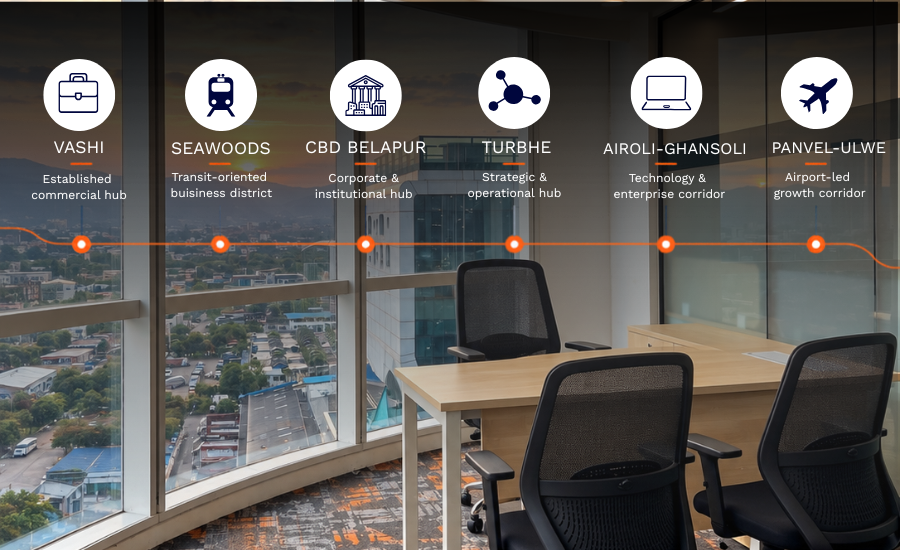
Navi Mumbai is increasingly becoming a market of several business districts rather than one dominant commercial centre. Vashi, Belapur, Airoli, Ghansoli, Seawoods and Turbhe have carved out distinct roles in Navi Mumbai’s business landscape, while Panvel, Ulwe, and Kharghar are emerging as important growth corridors.
The market is reflecting this shift in a tangible way. Cushman & Wakefield’s September 2025 report estimates 23.8 million sq. ft. of Grade A office stock, around 20% of MMR’s office stock, with 87% occupancy, and projects another 4 million sq. ft. of office supply by 2028.
So, what are the best business locations in Navi Mumbai? Let’s take a closer look at each of the districts in the blog below.
Why is Navi Mumbai Emerging as a Commercial Business Hub?
Navi Mumbai was planned to absorb Mumbai’s growth with organized development and infrastructure. Today, several factors explain its rising business profile:
1. Strong Regional Connectivity
Navi Mumbai’s multiple business nodes are linked by suburban rail, major road corridors and regional infrastructure. The Mumbai Trans Harbour Link has strengthened access between Navi Mumbai and South Mumbai, while the wider road network connects the city to Thane, Mumbai and Pune.
Cushman & Wakefield note that Atal Setu has reduced the Mumbai–Navi Mumbai connectivity from roughly 1–1.5 hours to under 30 minutes.
2. Diverse Commercial Ecosystem
Navi Mumbai is not dependent on a single business district. Companies can choose between established corporate areas, technology corridors, transit-oriented commercial developments and emerging airport-linked locations.
3. Access to Large Workforce
The region’s extensive residential network gives businesses access to talent across Navi Mumbai, Thane and parts of Mumbai. This becomes particularly important for companies with larger teams, where employee travel time can materially influence office-location decisions.
In a Cushman & Wakefield survey of more than 30 GCCs, 91% identified access to talent as a critical location factor.
4. Scope for Future Expansion
Navi Mumbai’s commercial footprint is still expanding. CRE Matrix reported 12.3 million sq. ft. of Grade A/A+ office space under construction in Navi Mumbai in February 2026 and described office rentals as 21% below Tier-1 city averages.
Key Navi Mumbai Districts Ideal for Business Setup
There is no single best commercial area in Navi Mumbai for every company. Each location has a different combination of connectivity, business ecosystem, office supply, and growth potential. Here’s a tabular comparison between each district:
| District | Best Suited for | Key Advantage | Connectivity |
|---|---|---|---|
| Vashi | Established companies & corporate teams | Mature commercial ecosystem | Rail, Palm Beach Road, Sion–Panvel corridor & NMIA |
| Seawoods | Established companies & corporate teams | Integrated, transit-oriented business environment | Rail, Sion–Panvel corridor, Palm Beach Road & NMIA |
| CBD Belapur | BFSI, IT, corporate & institutional companies | Established commercial & administrative powerhouse | Rail, road and metro connectivity & NMIA |
| Airoli-Ghansoli | IT, BPO, ITeS, and large corporate teams | Technology and corporate ecosystem | Rail, Thane–Belapur Road |
| Turbhe | SMEs, operational teams & corporate back-offices | Strategic central position | Rail, Thane–Belapur Road, Sion–Panvel corridor & NMIA |
| Panel-Ulwe | Logistics, aviation-linked businesses, & infrastructure-focused businesses | Airport-led growth | Highways, rail & NMIA |
Which Navi Mumbai Location is Right for Your Business?
There are several districts that serve as the best choice for office space in Navi Mumbai. They are:
1. Vashi
Ideal for: Established businesses, BFSI, IT offices, consulting and professional services.
Why it works: Vashi has one of the city’s more mature commercial ecosystems, with offices, retail, hospitality, and business services operating alongside established residential catchments.
What it offers: Corporate office buildings, flexible workspace options, retail and dining infrastructure, hotels and convenient access to neighbouring commercial districts.
Business advantage: A dependable choice for companies that want an established address and broad access rather than a highly specialised business cluster.
Businesses looking for a well-connected location can consider office space for rent in Vashi, particularly when proximity to established commercial infrastructure is a priority.
For businesses exploring flexible workplace options, Officebing offers managed office spaces in Vashi, combining a business-ready environment with flexible workspace requirements.
2. Seawoods
Ideal for: Corporate teams, consulting, professional services and businesses prioritising employee accessibility.
Why it works: Seawoods combines office, retail, hospitality and residential development around Seawoods–Darave Railway Station.
What it offers: Seawoods Grand Central alone includes 1.6 million sq. ft. of Grade A office space and 1.2 million sq. ft. of retail, with the railway station integrated into the development.
Business advantage: Few office locations make the commute quite so visible in their value proposition. The station is essentially at the doorstep, while the Sion–Panvel Expressway is about 3 km away.
Officebing offers managed offices right in Seawoods Grand Central, giving businesses access to a ready-to-use office environment within an established commercial district.
3. CBD Belapur
Ideal for: BFSI, financial services, consulting, legal, professional and institutional businesses.
Why it works: CBD Belapur has long functioned as an established administrative and commercial node.
What it offers: Corporate offices, government and institutional establishments, financial and professional services, and supporting commercial infrastructure.
Business advantage: A natural fit for businesses that value a formal business-district environment and proximity to established institutions.
4. Airoli and Ghansoli
Ideal for: IT, ITeS, GCCs, technology companies, shared services and large teams.
Why it works: Airoli and Ghansoli sit within the Thane–Belapur business corridor, one of Navi Mumbai’s strongest corporate and technology concentrations.
What it offers: Large business parks, Grade A office infrastructure, corporate amenities and workspace suited to sizeable teams.
Business advantage: This is less about having an impressive address and more about being close to the people and infrastructure that power technology-led businesses.
5. Turbhe
Ideal for: SMEs, trading businesses, operational teams and logistics-linked companies.
Why it works: Turbhe sits between several major commercial corridors and has strong connections to Thane–Belapur Road and the Sion–Panvel route.
What it offers: Commercial offices alongside a major trading and distribution ecosystem anchored by the Mumbai Agricultural Produce Market Committee.
Business advantage: Turbhe’s strategic position can outweigh the lack of a traditional premium-business-district image.
6. Panvel-Ulwe
Ideal for: Logistics, aviation-linked businesses, hospitality, travel and expansion-led enterprises.
Why it works: Navi Mumbai International Airport has changed the strategic equation for the southern part of the region.
What it offers: Access to aviation, cargo, logistics and hospitality opportunities.
Business advantage: JLL’s 2026 research describes the airport as a catalyst for a broader real estate corridor spanning Ulwe, Panvel, Kharghar, Taloja, New Panvel and Dronagiri, with new employment expected across aviation, cargo, logistics and hospitality.
What Should Businesses Consider Before Choosing an Office Location ?
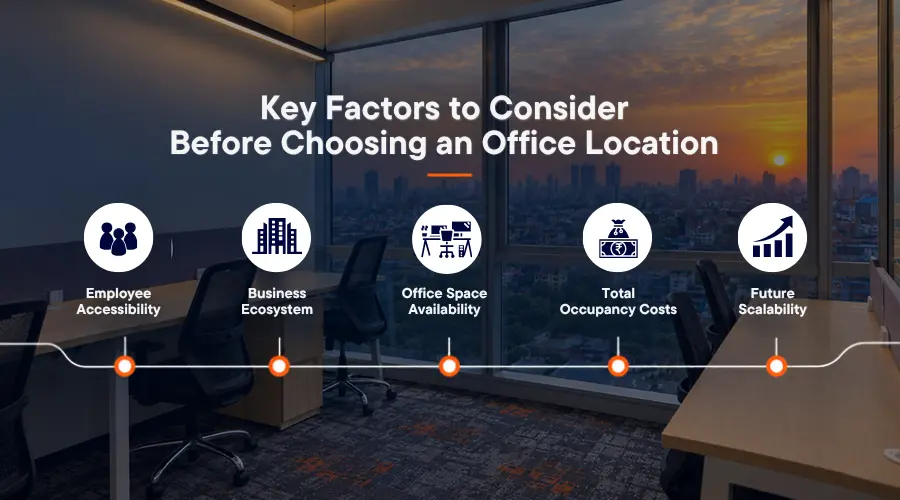
Comparing business districts based on rent alone can lead to the wrong decision. A more useful approach is to evaluate the following factors:
1. Employee Accessibility
A location that looks attractive on paper may become less effective if a large percentage of employees face long or complicated commutes.
2. Business Ecosystem
Being near banks, hotels, restaurants, professional services, corporate offices and commercial infrastructure can make day-to-day operations easier.
3. Office Space Availability
A 25-person company and a 200-person enterprise will have very different requirements. Evaluate whether the area can support your present requirement as well as future expansion.
4. Total Occupancy Costs
Look beyond rent to include deposits, maintenance, utilities, fit-outs, parking and other workplace costs. Cushman & Wakefield’s research reinforces why this matters: 77% of surveyed GCCs specifically highlighted cost-effective Grade A space as a location priority.
5. Future Scalability
An office should not become a bottleneck. Before choosing a location, ask:
- Can we add more seats?
- Is larger office space available nearby?
- Can we remain in the same business district as we expand?
- How will upcoming infrastructure affect accessibility?
Exploring Office Locations with Flexible Workspace Options
Once the location is shortlisted, the next question is the office model.
Flexible workspaces can be particularly relevant for companies balancing hybrid work, evolving headcounts and faster expansion cycles. This shift is also visible in India’s wider office market. CBRE reported that flexible workspace operators accounted for a significant share of office demand in 2025, alongside technology and BFSI occupiers.
For businesses evaluating managed offices, private offices or coworking spaces in Navi Mumbai, the right choice will depend on team size, desired flexibility, setup requirements and the level of operational support needed. A fully furnished office for rent offers companies a ready workplace without investing heavily in setup.
Officebing currently operates in Vashi, Seawoods, Turbhe and Ghansoli with an upcoming centre in Belapur, giving businesses options across some of Navi Mumbai’s most established commercial corridors.
Final Word
Navi Mumbai’s commercial advantage lies in its variety.
Vashi offers maturity. Seawoods puts connectivity front and centre. CBD Belapur brings an established corporate ecosystem, while Airoli and Ghansoli are closely tied to technology and enterprise activity. Turbhe makes a strong case for operational connectivity, Kharghar offers emerging corporate potential, and Panvel–Ulwe is being reshaped by airport-led growth.
The best place to set up an office is therefore not simply the one with the most prominent name. It is the location where your workforce can commute, your business can operate efficiently and your office can keep pace with the next chapter of growth.
For companies comparing best business locations in Navi Mumbai, the next step is to compare the workspace formats, costs and office configurations available within the shortlisted location.
FAQs
1. What are the best business locations in Navi Mumbai?
The best business locations in Navi Mumbai depends on the business. Airoli and Ghansoli are particularly suited to IT companies. CBD Belapur works well for professional services and institutional businesses, while Vashi and Seawoods are great choices for companies that prioritise established commercial infrastructure.
2. Is Vashi better than Airoli for setting up a business?
It depends on the business. Vashi is better suited to businesses that value a recognised commercial address, accessibility and client-facing activity, while Airoli is generally suitable for corporate, IT, and larger office requirements.
3. Which area in Navi Mumbai is the fastest growing?
Panvel and Ulwe are experiencing rapid growth due to massive projects like the Navi Mumbai International Airport and the Atal Setu (MTHL).
4. How much does it cost to rent office space in Navi Mumbai?
Office prices in Navi Mumbai vary by location, building grade, office size and amenities. Managed and furnished offices typically offer flexible per-seat pricing, while conventional commercial spaces may involve additional costs for interiors, maintenance and utilities.